
Frequently asked questions
Company News
- Aluminum veneer customization, creating a new trend of personalized space
- Aluminum veneer curtain wall, the fashionable "coat" of modern architecture
- Aluminum veneer customization, creating an exclusive personalized space
- Aluminum veneer punching, infinite extension of creative space
- Aluminum veneer curtain wall: a fashionable outerwear for urban architecture
Industry dynamics
- Manufacturing process of fluorocarbon coated aluminum veneer
- Curtain Wall Aluminum Veneer: Guardian of Modern Architectural Aesthetics
- The unique charm of punched aluminum veneer reveals its perfect combination of environmental protection and fashion!
- Aluminum veneer curtain wall: the new darling of modern architecture, how much do you know?
- Characteristics and advantages analysis of curved carved aluminum veneer
Frequently asked questions
- How to improve the fire resistance of aluminum veneer?
- What is the insulation performance of aluminum veneer?
- What are the surface treatment methods for aluminum veneer?
- What is the installation method of aluminum veneer?
- How to improve the sound insulation performance of aluminum veneer?
contact us
Mobile phone: 15627778610
Email: 2201229786
Address: No. 5 Binjiang Road, High tech Zone, Zhaoqing City
How to improve the sound insulation performance of aluminum veneer?
- Author: Xinlongtai Aluminum Industry (Guangdong) Co., Ltd
- Release time: 2022-02-27 08:43:24
- Click:0
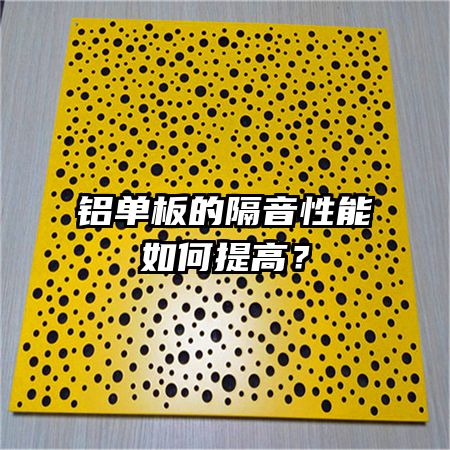
How to improve the sound insulation performance of aluminum veneer?
Abstract: Sound insulation is an important consideration in architectural design and decoration. As a commonly used building material, aluminum veneer also has certain performance in sound insulation. This article will explore how to improve the sound insulation performance of aluminum veneer from four aspects.
1、 Material selection
1. Choosing the appropriate aluminum alloy: Different types of aluminum alloys have different effects on the transmission and reflection of sound waves. Choosing aluminum alloys with moderate density can effectively absorb noise and reduce conduction.
2. Adding sound insulation materials: Adding sound insulation materials such as sound insulation cotton, sound insulation film, etc. inside the aluminum veneer can increase the sound insulation effect. These materials can absorb sound waves and reduce the propagation of noise.
3. Consider thickness: Increasing the thickness of aluminum veneer can improve its sound insulation performance. Thicker aluminum veneer can better block the propagation of sound waves.
2、 Structural Design
1. Adopting a multi-layer structure: The multi-layer structure can effectively isolate noise, absorb and reflect it. In the design of aluminum veneer, it is possible to consider adding interlayers or other sound-absorbing materials to increase the sound insulation effect.
2. Reduce resonance points: Resonance can cause sound wave transmission and amplification, affecting the sound insulation effect. By designing a reasonable structure and reducing the occurrence of resonance points, the sound insulation performance of aluminum veneer can be improved.
3. Sealing edge: There may be gaps between the aluminum veneer and the building structure, which can cause noise leakage. By sealing the edges, noise leakage can be avoided and the sound insulation effect can be improved.
3、 Surface treatment
1. Adopting sound-absorbing coating: Coating sound-absorbing coating on the surface of aluminum veneer can increase the material's sound-absorbing ability and improve the sound insulation effect.
2. Choose a smooth surface: A smooth surface can reduce the reflection of sound waves and decrease the propagation of noise. The surface treatment of aluminum veneer should be as smooth and even as possible to reduce the reflection of noise.
3. Using sound-absorbing texture design: Designing sound-absorbing textures on the surface of aluminum veneer can increase its sound-absorbing effect. These textures can help absorb sound waves and reduce the propagation of noise.
4、 Installation and Connection
1. Reduce vibration: Aluminum veneer may generate vibration during installation, affecting the sound insulation effect. By using appropriate installation methods and connectors, the occurrence of vibration can be reduced, which can improve the sound insulation performance of aluminum veneer.
2. Sealed connection points: Using sealing materials to seal the connection points of aluminum veneer can prevent noise leakage. This can ensure better sound insulation of the entire aluminum veneer system.
3. Consider combining other sound insulation measures: In addition to the sound insulation design of the aluminum veneer itself, combining other sound insulation measures such as air layers, sound-absorbing walls, etc. can further improve the overall sound insulation effect.
Summary:
With the increasing demand for building environment comfort and noise control, aluminum veneer, as a commonly used building material, also has sustainable room for improvement in sound insulation performance. By selecting appropriate materials, structural design, surface treatment, and installation connections, the sound insulation performance of aluminum veneer can be effectively improved, providing better noise control for buildings. Future research can further explore new sound insulation materials and design concepts, enabling aluminum veneer to play a greater role in the field of sound insulation.
 Customer service QQ