
Industry information
Company News
- Aluminum veneer curtain wall: the "fashionable coat" of modern architecture
- How much do you know about aluminum veneer curtain wall: the fashionable coat of architecture?
- Aluminum veneer curtain wall: the new darling of future architectural aesthetics?
- Curtain wall aluminum veneer: the "invisible hero" of architectural art
- Aluminum veneer customization, creating your own personalized space
Industry dynamics
- Customized aluminum veneer, creating a new trend of personalized space
- Aluminum veneer: the green choice in modern architecture
- Design and installation techniques for perforated aluminum veneer on exterior walls
- Aluminum veneer curtain wall, the fashionable "coat" of modern architecture
- Aluminum veneer customization makes your home more tasteful
Frequently asked questions
- How to improve the insulation performance of aluminum veneer?
- How to improve the fire resistance of aluminum veneer?
- What is the insulation performance of aluminum veneer?
- What are the common methods for surface treatment of aluminum veneer?
- What is the sound insulation performance of aluminum veneer?
contact us
Mobile phone: 15627778610
Email: 2201229786
Address: No. 5 Binjiang Road, High tech Zone, Zhaoqing City
The environmental characteristics of aluminum veneer and its application in green buildings
- Author: Xinlongtai Aluminum Industry (Guangdong) Co., Ltd
- Release time: February 27, 2025 21:03:55
- Click:0
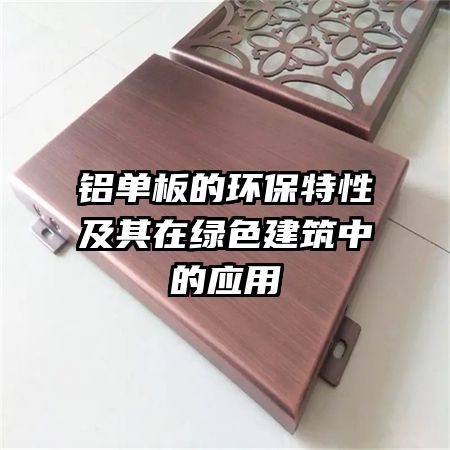
The environmental characteristics of aluminum veneer and its application in green buildings
Abstract: This article will elaborate on the application of aluminum veneer in green buildings and its environmental characteristics. By analyzing its renewability, energy efficiency, low-carbon emissions, and resource recycling, the advantages of aluminum veneer as an environmentally friendly building material are demonstrated. This article also cites relevant research and viewpoints to provide support.
1、 Renewability
1. The renewability of aluminum veneer is mainly reflected in the utilization of aluminum resources during its manufacturing process. Aluminum is one of the abundant metals in the Earth's crust, and the production process of aluminum veneer can achieve almost 100% aluminum resource recovery and reuse. This means that using aluminum veneer will not put excessive pressure on aluminum resources, while reducing damage to the natural environment.
2. In addition, the manufacturing process of aluminum veneer is relatively simple, does not require extensive chemical treatment, and can be recycled through remelting. This makes aluminum veneer have good sustainability and meet the requirements of green buildings.
3. A study by Harvard University shows that the recycling rate of aluminum veneer reaches over 90%, far higher than other metal materials, which gives aluminum veneer greater advantages in the field of sustainable construction.
2、 Energy efficiency
1. Aluminum veneer has good energy efficiency, mainly reflected in its manufacturing process and usage stage. Compared to traditional building materials, the manufacturing process of aluminum veneer requires less energy, reducing energy consumption.
2. In the usage stage, aluminum veneer has superior thermal conductivity, which can effectively insulate and keep warm, reducing the energy consumption of buildings. Research has shown that using aluminum veneer exterior wall systems can reduce energy loss by at least 30% and provide more precise control over indoor temperature and humidity.
3. In addition, aluminum veneer has a long service life and is not easily affected by oxidation and corrosion, reducing maintenance and replacement costs. Therefore, the energy efficiency of aluminum veneer makes it an ideal choice for green buildings.
3、 Low carbon emissions
1. The carbon emissions generated during the manufacturing process of aluminum veneer are relatively low. Compared with traditional building materials, the production process of aluminum veneer requires less energy, reducing carbon emissions caused by energy consumption.
2. In addition, aluminum veneer has a long service life and can provide long-lasting protection and decorative functions. Compared with other building materials, aluminum veneer has lower maintenance and repair costs, reducing additional carbon emissions.
3. According to the United Nations Environment Programme, the use of aluminum veneer exterior wall materials can reduce the carbon emissions of buildings by about 30%, corresponding to significant energy savings and reduced greenhouse gas emissions.
4、 Resource recycling and utilization
1. Almost 100% aluminum resource recovery and reuse can be achieved in the manufacturing process of aluminum veneer. Compared with other metal materials, aluminum veneer has a higher resource recycling rate.
2. By recycling and reusing aluminum veneer, the demand for new aluminum resources can be reduced, saving natural resources. Meanwhile, reusing aluminum veneer also reduces the generation of waste and negative impact on the environment.
3. The research results of the US Environmental Protection Agency show that recycling and reusing aluminum veneer is equivalent to saving 90% of energy and reducing 95% of greenhouse gas emissions.
5、 Summary:
In summary, aluminum veneer, as an environmentally friendly building material, has important application value in green buildings. Its characteristics of renewability, energy efficiency, low carbon emissions, and resource recycling make it a key factor in sustainable development. In future architectural design and construction, more use of aluminum veneer should be made to promote the development of the construction industry towards a more environmentally friendly and sustainable direction.
 Customer service QQ